Science Student Portal · Astronomy & Astrophysics · Tier 1
Scientific Scale, Observation, and the Language of Space
AST-101 establishes the quantitative vocabulary needed to describe astronomical distance, radiation, geometry, and measurement limits. Treat every displayed value as a statement with units, a scale, a method, and a stated degree of confidence.
Module Identification
Discipline: Astronomy & Astrophysics
Tier / course: Tier 1 — Foundations · AST-101: Foundations of the Cosmos
Module: Module 1 — Scientific Scale, Observation, and the Language of Space
Required tools: Pencil or pen, paper, and a four-function calculator. A printed copy of the reference table and laboratory worksheet is sufficient; no internet connection, telescope, or special equipment is required.
Working expectation: Preserve units on every line of a calculation. Do not treat a number as a result until its unit and the meaning of the quantity are clear.
Scope Statement
This module introduces the numerical scale of astronomy, the distance units used at solar-system and stellar scales, electromagnetic radiation as an information carrier, simple observing geometry, and disciplined treatment of significant figures and uncertainty. Its purpose is to give learners a technically defensible language for reading introductory astronomy, not to replace an astrometry, physics, or observational-methods course.
Powers of ten; AU, light-year, parsec, angular units; atmospheric windows; basic trigonometric parallax; unit conversion; order-of-magnitude estimation; and uncertainty-aware reporting.
Telescope operation, detector calibration, image reduction, spacecraft navigation, relativistic distance measures, the full cosmological distance ladder, and professional astrometric data analysis.
Diagrams and worked values are teaching models. They are not navigation data, engineering specifications, medical guidance, or a substitute for instrument documentation. In any scientific communication, distinguish what was observed, calculated, inferred, modeled, and assumed.
Measurable Learning Outcomes
- Order astronomical quantities by power of ten and explain why logarithmic representations are appropriate for extreme scale ranges.
- Convert a stated distance among kilometres, astronomical units, light-years, and parsecs while preserving units and appropriate significant figures.
- Explain how wavelength, frequency, and photon energy relate, and identify which regions of the electromagnetic spectrum require space-based observation.
- Use degrees, arcminutes, and arcseconds to interpret basic observing geometry and calculate stellar distance from an idealized parallax angle.
- Communicate a numerical astronomical result using scientific notation, an order-of-magnitude estimate, supported significant figures, and an explicit uncertainty or model limitation.
Core Concept Map & Reference
order of magnitude
scientific notationSignal
wavelength · frequency
photon energyGeometry
angles · baseline
parallaxUnits
km · AU · ly · pcEvidence
detector · calibration
atmospheric windowQuality
significant figures
uncertainty · assumptions
Essential vocabulary and common confusions
- Order of magnitude
- The nearest power of ten used to compare scale quickly. A difference of three orders of magnitude is a factor of one thousand.
- Astronomical unit (AU)
- A defined distance equal to 149,597,870,700 m. It is useful for solar-system scale, not a changing daily Earth–Sun distance.
- Light-year (ly)
- A distance: how far light travels in one Julian year. It is not a duration.
- Parsec (pc)
- The distance at which 1 AU subtends 1 arcsecond. It is directly tied to parallax geometry; 1 pc ≈ 3.2616 ly.
- Wavelength / frequency
- Two linked descriptions of electromagnetic radiation. In vacuum, c = λν. A shorter wavelength has a higher frequency.
- Parallax
- An apparent shift in direction produced by observing from different points. It is an angle, not a physical side-to-side motion of the star.
Astrophysical constants & conversion reference
| Quantity | Symbol | Reference value | Use / qualification |
|---|---|---|---|
| Speed of light in vacuum | c | 299,792,458 m s−1 (exact) | Defines the metre; use for light-travel calculations in vacuum. |
| Newtonian gravitational constant | G | 6.67430 × 10⁻¹¹ m3 kg−1 s−2 | Measured constant with uncertainty; included as a reference for later modules, not used in this module’s calculations. |
| Astronomical unit | AU | 149,597,870,700 m (exact) | Standard distance unit for solar-system scale. |
| Light-year | ly | 9.46073047258 × 10¹⁵ m | c multiplied by one Julian year; report approximately when source values are rounded. |
| Parsec | pc | 3.085677581 × 10¹⁶ m | ≈ 3.26156 ly; defined from AU and one arcsecond. |
| Solar mass | M⊙ | ≈ 1.9885 × 1030 kg | Useful scale reference. For high-precision work, use the relevant nominal solar parameter stated by the source. |
| Solar radius | R⊙ | 6.957 × 10⁸ m | IAU nominal solar radius used as a conventional scale reference. |
1 km = 103 m1 AU = 1.495978707 × 10⁸ km1 ly ≈ 63,241 AU1 pc ≈ 206,264.806 AU ≈ 3.26156 lyd(pc) = 1 / p(arcsec)d(ly) ≈ 3.26156 / p(arcsec)Constants are rounded where that supports learning. The source-validation record in Section 10 names the authoritative references. Never add calculator digits that the input data do not justify.
Learning Sequence
How to use this lecture: Read with a pencil. Mark every time a quantity changes unit, every time a visual is a schematic rather than a measurement, and every time the result depends on an assumption. Those distinctions are the operational language of science.
1.1
The Architecture of Scale
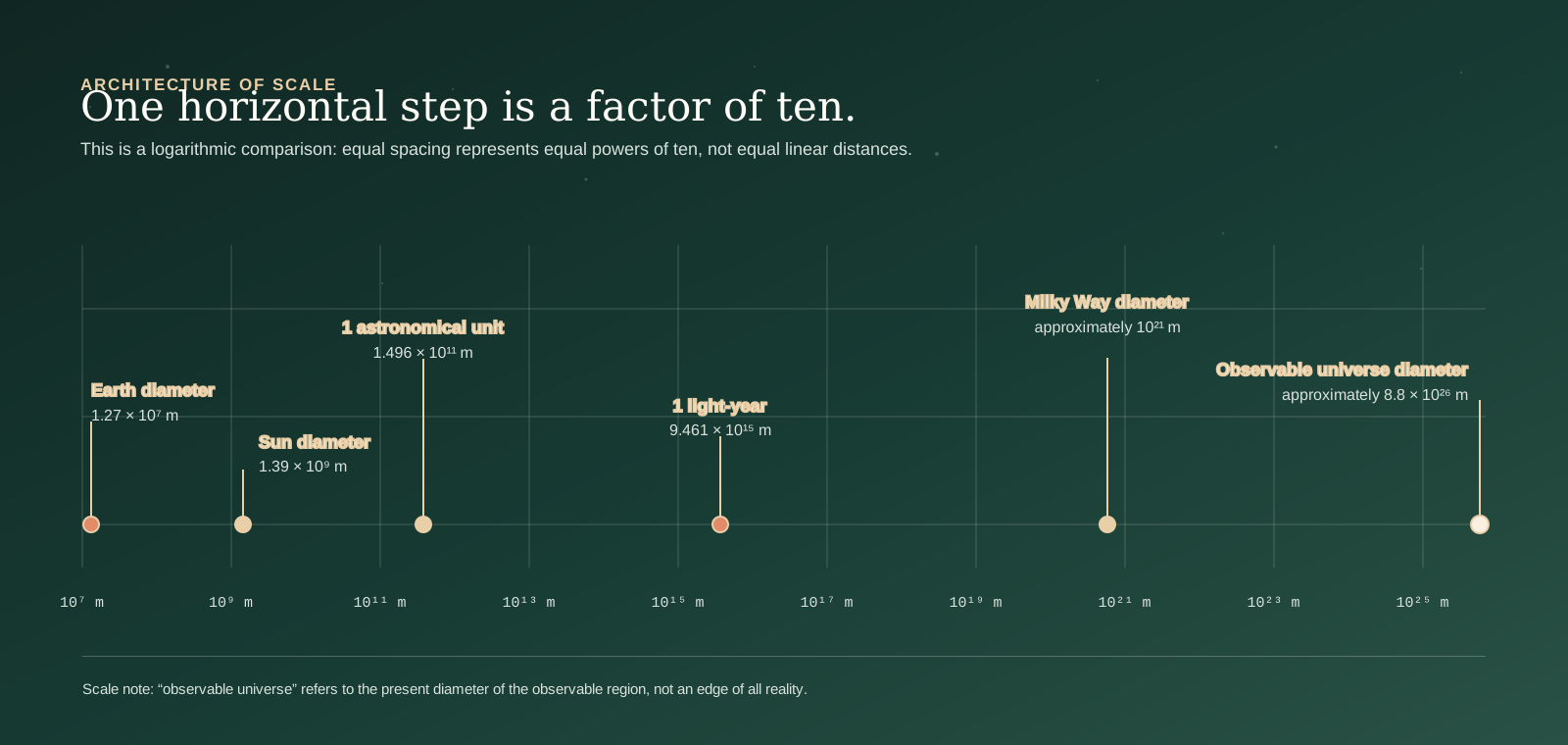
Astronomy is difficult to discuss in ordinary linear intuition because the relevant sizes span many powers of ten. Earth’s diameter is approximately 1.27 × 10⁷ m. The diameter of the observable universe is commonly expressed at roughly 8.8 × 1026 m. The ratio is about 6.9 × 10¹⁹: nearly twenty orders of magnitude. A straight ruler that makes Earth visible would compress much of the universe into an unusable point; a logarithmic axis makes the comparison legible.
On a logarithmic scale, moving one major interval means multiplying length by ten. Moving from 107 m to 1010 m is not “three units farther”; it is 1,000 times larger. This matters because scale governs the measurement method. A tape measure is reasonable for a room, radar timing can be useful within the solar system, trigonometric parallax can constrain nearby stellar distances, and other methods are required at galactic or cosmological scales.
| Reference quantity | Approximate size in metres | Order of magnitude | Interpretive note |
|---|---|---|---|
| Earth diameter | 1.27 × 10⁷ m | 107 m | Planetary scale |
| Sun diameter | 1.39 × 10⁹ m | 109 m | Stellar scale |
| Earth–Sun reference distance | 1.496 × 10¹¹ m | 1011 m | One AU |
| One light-year | 9.461 × 10¹⁵ m | 1016 m | Interstellar distance unit |
| Milky Way diameter | about 1021 m | 1021 m | Galaxy scale; definition depends on component measured |
| Observable-universe diameter | about 8.8 × 1026 m | 1027 m | Cosmological scale; model-dependent |
1.2
Astronomical Units of Measurement
Units are not labels added after calculation; they determine what the number means. Kilometres are practical for many planetary distances but become unwieldy when large. The astronomical unit (AU) compresses solar-system distances by using a fixed defined reference: 1 AU = 149,597,870,700 m. It is close to the mean scale of Earth’s orbit around the Sun, but it is not “today’s Earth–Sun distance” and it should not be used carelessly for a changing point-to-point distance between planets.
A light-year is the distance light travels through vacuum in one Julian year, approximately 9.4607 × 10¹² km. Because light speed is finite, a source 4.37 ly away is observed as it was 4.37 years earlier—not because a light-year is time, but because the distance and the propagation speed determine travel time. The parsec has a geometric origin: at 1 pc, 1 AU subtends an angle of 1 arcsecond. Parsecs make stellar parallax calculations compact, and kiloparsecs (kpc) or megaparsecs (Mpc) are common at larger scales.
Worked conversion A — kilometres to AU
Question: A distance is 7.785 × 10⁸ km. Express it in AU.
- Write the conversion factor so kilometres cancel:
7.785 × 108 km × (1 AU / 1.495978707 × 10⁸ km). - Divide the coefficients:
7.785 ÷ 1.495978707 ≈ 5.204. - Divide the powers of ten:
108 / 108 = 100. - State the result with supported precision:
≈ 5.204 AU.
The unit cancellation is the error-control step. It demonstrates that a length in kilometres has become a length in AU, rather than merely changing the displayed digits.
Worked conversion B — light-years to parsecs
Question: A nearby star system is 4.37 ly away. Express the distance in parsecs.
- Use
1 pc ≈ 3.26156 ly. - Set up the factor:
4.37 ly × (1 pc / 3.26156 ly). - Calculate:
4.37 ÷ 3.26156 = 1.34to three significant figures. - Report:
4.37 ly ≈ 1.34 pc.
Worked conversion C — AU to light travel time
Question: How long does light take to cross 1 AU in vacuum?
- Use
t = d / c. - Substitute defined values:
t = 149,597,870,700 m / 299,792,458 m s−1. - Cancel metres and calculate:
t = 499.0 s. - Convert seconds to minutes:
499.0 s ÷ 60 = 8.32 min.
Result: Light travels from the Sun’s reference distance of 1 AU to Earth in about 8 minutes 19 seconds. Actual Sun–Earth light time changes slightly with orbital position.
1.3
The Electromagnetic Window
Almost all astronomical information reaches a detector as electromagnetic radiation. Radio waves, infrared, visible light, ultraviolet, X-rays, and gamma rays are not unrelated substances; they are regions of one electromagnetic spectrum. In vacuum they travel at the same speed, c. Their frequency ν, wavelength λ, and photon energy E are linked by c = λν and E = hν = hc/λ. Short wavelength means high frequency and high energy per photon.
Wavelength changes what can be inferred. Visible observations can show stellar photospheres and reflected light. Infrared can probe warm material and, in some circumstances, reveal sources behind dust that blocks visible light. Radio observations can trace cold gas, synchrotron emission, or spectral lines. High-energy observations can identify very hot, rapidly accelerated, or otherwise energetic processes. The correct scientific question is never “Which picture is real?” It is “What does this detector measure, at what wavelength, with what response and processing?”
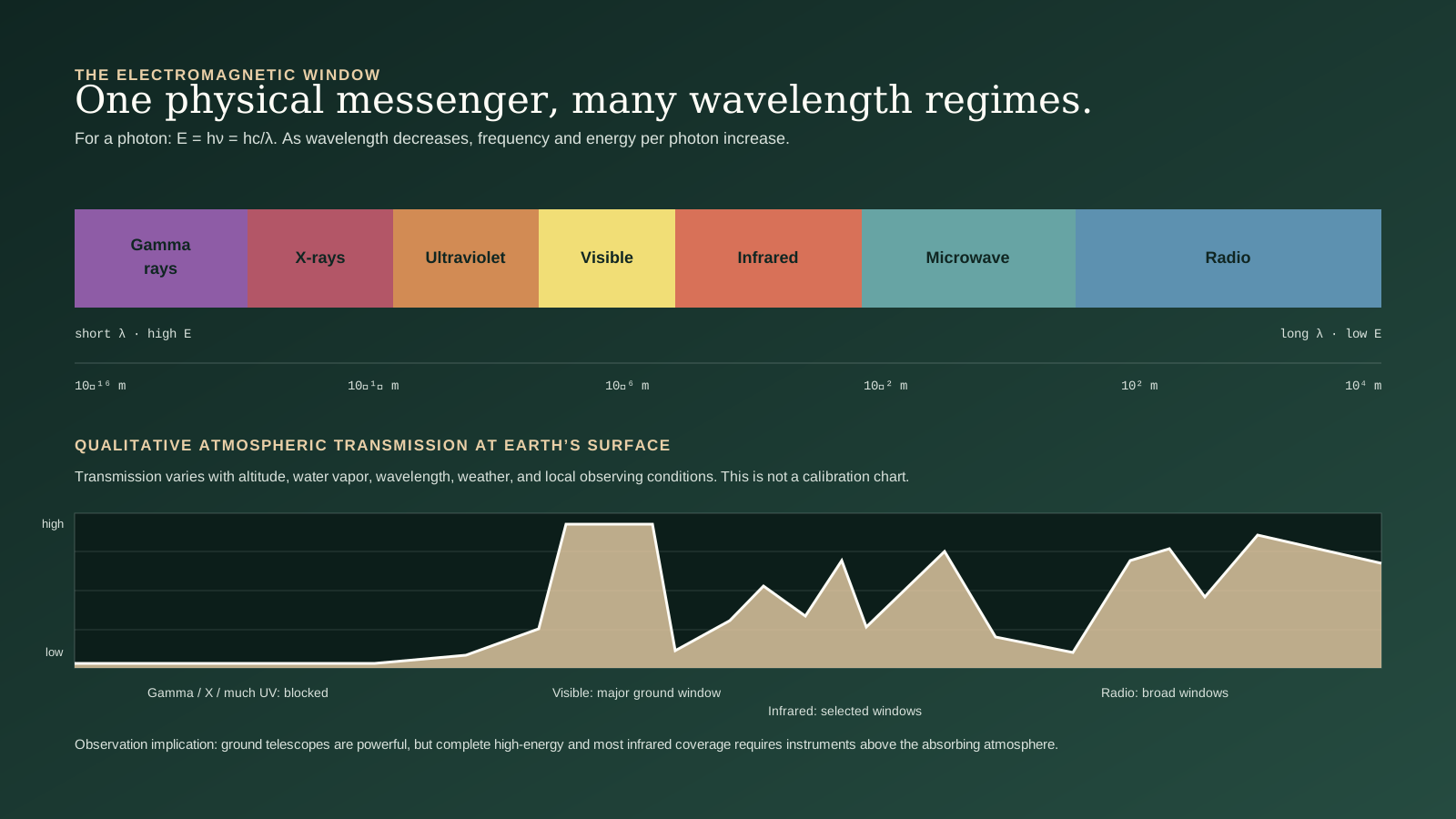
Earth’s atmosphere is scientifically consequential in two directions. It makes ground astronomy possible through windows in visible light and much of the radio spectrum. It also absorbs or scatters most gamma rays, X-rays, much ultraviolet, and large portions of infrared radiation. This is why some astronomy must use high mountains, balloons, rockets, or orbiting observatories. Space-based placement is not a prestige feature; it is a response to the propagation environment between source and detector.
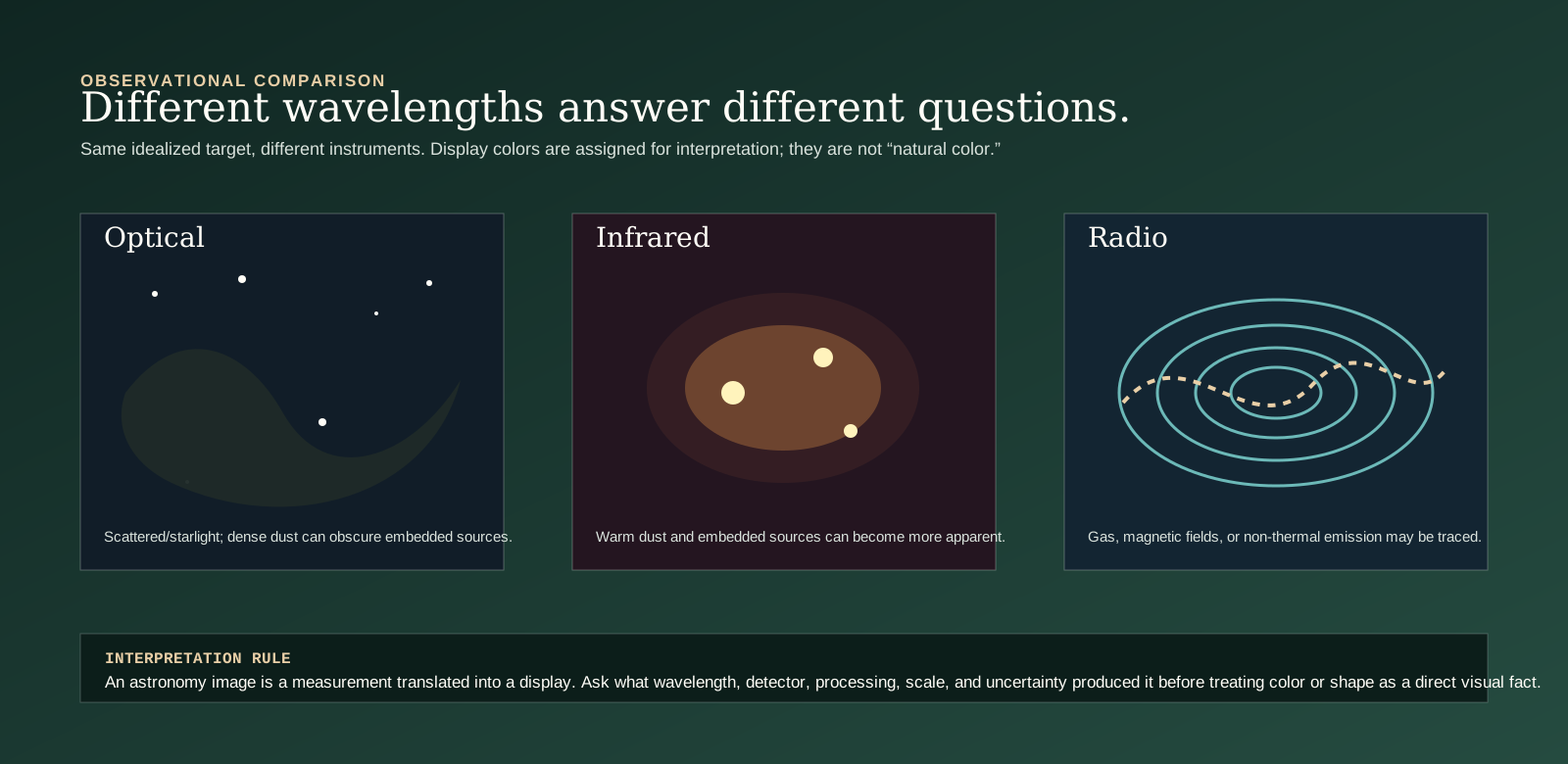
“Image” in astronomy is often a convenience word for a calibrated dataset rendered for human interpretation. A display color may encode wavelength, intensity, a ratio, or a processed data product—not the color an unaided human eye would see.
1.4
Observational Geometry & Parallax
Astronomy frequently measures direction before it can measure distance. Direction is angular: a full circle contains 360 degrees (°); 1 degree contains 60 arcminutes (′); and 1 arcminute contains 60 arcseconds (″). Therefore, 1° = 3,600″. These are small angular units, not units of linear length. A 1 arcsecond angle can correspond to a very different physical distance depending on the range to the object.
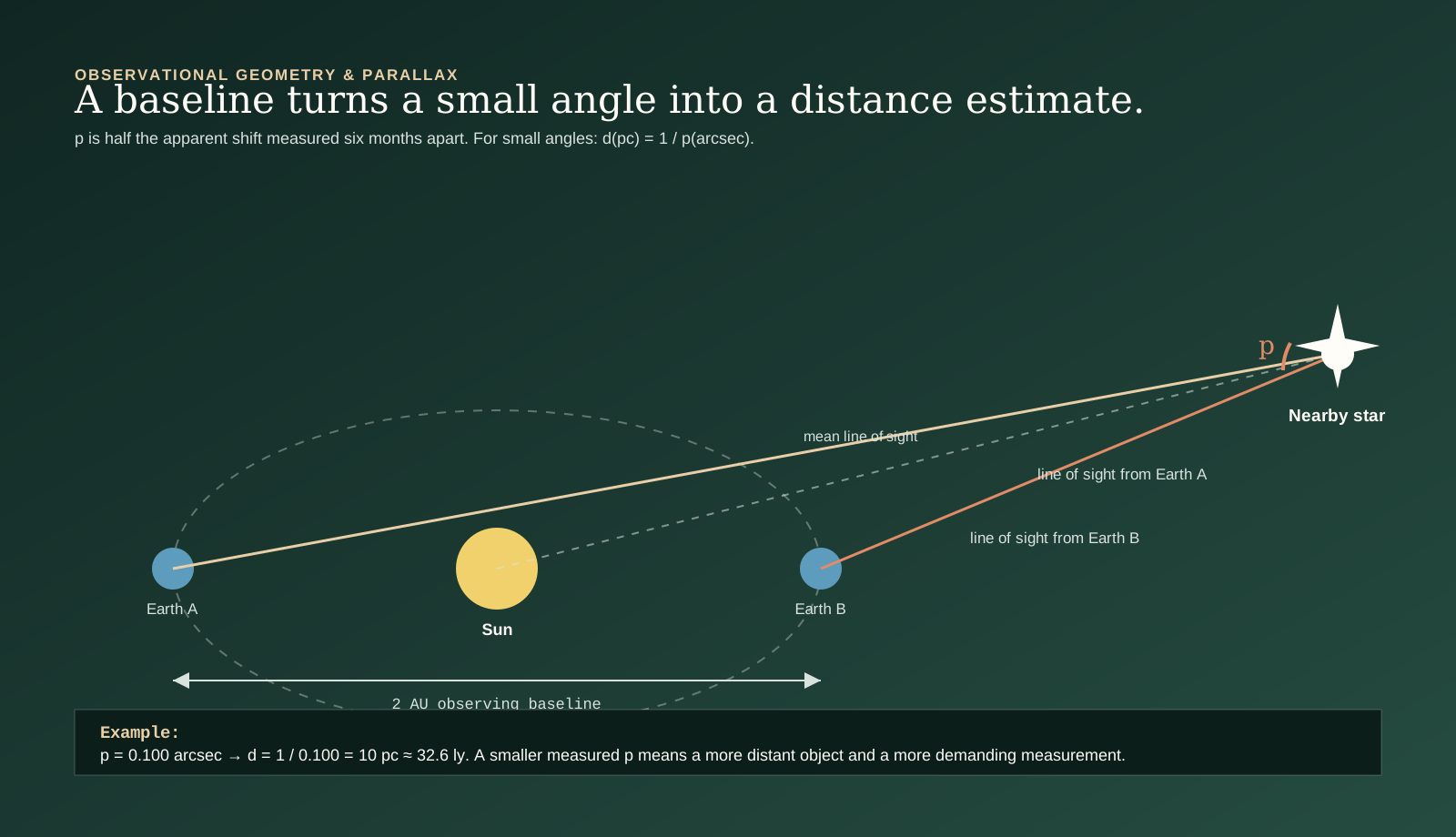
Parallax is an apparent change in the direction of a nearby object relative to distant background objects when the observer moves. For annual stellar parallax, observations are made approximately six months apart, using opposite sides of Earth’s orbit. The full baseline is close to 2 AU. By convention, the parallax angle p is half the total apparent angular shift: it is the angle subtended by 1 AU at the star. For small angles, the parsec relationship is compact: d(pc) = 1 / p(arcsec).
Worked parallax calculation
Question: A star has a measured parallax of p = 0.100″. What is its distance?
- Write the governing relationship:
d(pc) = 1 / p(arcsec). - Substitute the measured angle:
d = 1 / 0.100. - Calculate:
d = 10 pc. - Convert for a learner who needs light-years:
10 pc × 3.26156 ly/pc = 32.6 ly.
Report: d = 10 pc ≈ 32.6 ly, under the simple parallax model.
Parallax is powerful but not unlimited. As a target becomes more distant, p becomes smaller. If the uncertainty in p is a substantial fraction of the angle itself, direct inversion can become unstable: a tiny difference in angle produces a large difference in inferred distance. This is not a reason to avoid calculation. It is a reason to report the uncertainty and not mistake a model output for an error-free fact.
1.5
Scientific Notation & Uncertainty in Astrophysics
Scientific notation separates scale from coefficient: 6.37 × 10⁶ m states a number between 1 and 10 multiplied by an explicit power of ten. It makes multiplication, division, and comparison transparent. For example, (3.0 × 108) × (2.0 × 104) = 6.0 × 10¹². In division, subtract exponents: (8.0 × 10¹²) / (2.0 × 10³) = 4.0 × 10⁹.
Significant figures communicate what the input data can support. If a distance is reported as 4.37 ly, it has three significant figures. A conversion should not claim ten digits merely because a calculator can print them. The useful rule is not “round every answer to the same number of decimals”; it is “report precision consistent with the least precise input and the stated model.” Exact definitions such as c and AU do not limit precision, but rounded observational inputs do.
Estimate before calculating. Example: 1 AU is about 1.5 × 10¹¹ m and c is about 3 × 10⁸ m/s. Thus t ≈ (1.5/3) × 103 s = 0.5 × 10³ s ≈ 500 s, or about 8 minutes. The estimate predicts the exact calculation’s scale.
Random variation can change around a central value with repeated measurement. Systematic error shifts results in a consistent direction because of calibration, selection, background, or model assumptions. Repetition alone may reduce random uncertainty but does not automatically repair a systematic bias.
For small relative uncertainty, d = 1/p implies approximately δd/d ≈ δp/p in magnitude. When parallax signal is weak or uncertainty is comparable to p, distance inference requires more careful statistical treatment than simple inversion.
Every numerical astronomy statement should be auditable. A reader should be able to identify the quantity, unit, reference system, method, assumptions, and uncertainty. “The star is 32.6 light-years away” is incomplete unless context establishes whether that is a rounded parallax-derived estimate, a catalog value, a model distance, or a teaching approximation.
Knowledge Checks
Four low-stakes practice checks. They work entirely in the browser and do not send answers anywhere. Use the feedback to correct reasoning before beginning the laboratory or cumulative exam.
Works offlineEnd-of-Module Cumulative Exam
CEU threshold: 80% or higher (8 of 10 points) is required for a future platform CEU completion record. Questions 1–8 are one point each and can be scored locally; Questions 9–10 are short-answer analysis problems that require rubric review. The local score is formative until the written work and laboratory artifact are verified.
Integrity direction: Complete the exam without consulting the worked examples, then use the review feedback to identify missed concepts. Print the packet or preserve the written calculations for formal review when that process is enabled.
9. Scientific notation analysis — 1 point
A source is listed at 4.5 × 10¹⁸ km. Convert the distance to metres and then to light-years. Show your unit-cancellation setup and report the final light-year value to two significant figures.
Rubric: 1 point for a correct dimensional setup and a supported result: 4.5 × 10²¹ m; approximately 4.8 × 10⁵ ly.
10. Parallax distance analysis — 1 point
A star’s parallax is 0.050 arcseconds. Calculate its distance in parsecs, light-years, and AU. State one reason the reported precision should not exceed the precision of the measured parallax.
Rubric: 1 point for the correct method and an appropriately rounded result: 20 pc; about 65 ly; about 4.1 × 10⁶ AU; plus a valid precision/uncertainty statement.
Applied Evidence of Learning
Offline practical laboratory
Calculating Cosmic Scale & Light Travel Time
This paper-and-calculator exercise evaluates whether you can use the module’s reference data without internet access. It is a calculation and scientific-communication lab, not an observing exercise.
Printed module or reference table, blank paper, pencil, and a four-function calculator. Use a calculator only after writing the formula and dimensional conversion.
One calculation sheet with all unit cancellations shown, answers rounded to supported precision, and one paragraph identifying an assumption or limitation for the result.
40–50 minutes. Work independently first; compare method, not just answers, during review.
Part A — One-way light-travel delays
Use t = d/c, with c = 299,792.458 km/s. The listed planetary distances are supplied one-way snapshot separations for calculation practice; they are not permanent orbital distances. Convert each result to seconds and then to minutes or years where appropriate.
| Target / provided distance | Required calculation | Student result | Interpretive statement |
|---|---|---|---|
| Venus — 4.14 × 10⁷ km | t = d/c; report min | ||
| Mars — 7.83 × 10⁷ km | t = d/c; report min | ||
| Jupiter — 6.28 × 10⁸ km | t = d/c; report min | ||
| Alpha Centauri system — 4.37 ly | State light-travel time | ||
| Andromeda Galaxy — 2.54 × 10⁶ ly | State light-travel time |
Self-check values, to the precision supported by the provided data: Venus ≈ 2.30 min; Mars ≈ 4.35 min; Jupiter ≈ 34.9 min; Alpha Centauri ≈ 4.37 years; Andromeda ≈ 2.54 million years. Show your work before reviewing these values.
Part B — Stellar distances from parallax
Use d(pc) = 1/p(arcsec), then convert to light-years using 1 pc = 3.26156 ly. For each row, write one sentence explaining whether the parallax is relatively easy or more difficult to measure compared with the other rows, and why.
| Parallax p | Distance in pc | Distance in ly | Measurement interpretation |
|---|---|---|---|
| 0.500″ | |||
| 0.125″ | |||
| 0.040″ |
Self-check values: 0.500″ → 2.00 pc ≈ 6.52 ly; 0.125″ → 8.00 pc ≈ 26.1 ly; 0.040″ → 25.0 pc ≈ 81.5 ly. Smaller parallax means greater distance and requires more angular precision.
- 4 points: formulas, substitution, and units shown accurately
- 3 points: correct distance / time conversions to supported precision
- 2 points: correct parallax calculations and comparison reasoning
- 1 point: explicit statement of a relevant assumption, uncertainty, or model limitation
Evidence standard: A result without units or visible method is not a complete laboratory result. If an answer differs from the self-check, locate the first line where a unit, exponent, or conversion factor changed.
Accessibility and Student-Support Requirements
- Offline first: all diagrams in this module are local SVG assets and all interactions run in the browser; no external image host, font library, audio track, or required web service is used.
- Printable packet: use the Print module packet control to remove navigation and preserve the calculation worksheets, tables, visual captions, and written-response fields.
- Visual alternatives: every figure has meaningful alternative text and a caption that identifies whether the graphic is a schematic, qualitative model, or a scale reference. Do not rely on color alone to interpret the content.
- Mathematical readability: equations also appear as plain text with units. Learners may use a four-function calculator, large-print reference table, or a reader / scribe accommodation without changing the learning outcome.
- Language support: the complete Spanish edition follows the site-wide EN / ES preference while preserving units, formulas, and standard symbols. Technical terminology and numerical notation should be re-reviewed by a qualified bilingual astronomy / physics reviewer before any external CEU claim.
- Student support boundary: this is introductory scientific education. Students needing advanced astrometry, data-reduction, engineering, or observational safety guidance should use an appropriate accredited course, observatory, or technical source.
CEU and Completion Record
| Verified contact hours | 2.0 hours |
|---|---|
| Platform CEU record value | 0.2 platform CEU |
| Formative knowledge checks | Four checks completed; feedback reviewed. These checks prepare the learner but do not independently award credit. |
| Cumulative exam threshold | 80% or higher: at least 8 of 10 points. Questions 1–8 are multiple choice; Questions 9–10 require rubric review. |
| Applied evidence requirement | Completed “Calculating Cosmic Scale & Light Travel Time” worksheet with units, calculations, and an uncertainty / limitation statement. |
| Completion status | Pending verified assessment workflow |
| Learner integrity acknowledgment | Required before a future CEU completion record is issued. |
| Certificate / transcript eligibility | Not eligible until assessment, applied evidence, contact-hours verification, and the platform’s formal CEU approval process are complete. |
Curriculum Quality Record
Version / revision dateAST-101-M1 v1.1 · 2026-08-08
Curriculum statusPublished foundational module. Future modules in AST-101 remain in development.
Subject-matter reviewTechnical content requires review by a qualified astronomy / physics subject-matter reviewer before any external CEU claim.
Safety / ethics reviewEducational scope only. No live observing, equipment operation, navigation, or safety-critical instruction is claimed.
Accessibility reviewOffline, print, semantic-table, caption, alternative-text, and English / Spanish implementation included; revalidate after any localization or content change.
Visual asset recordFigures 1–4 are locally authored teaching diagrams. They are not calibrated measurements or manipulated telescope images.
Source-validation log
- NASA Science — Cosmic Distances. AU, light-year, parsec context and Alpha Centauri reference scale.
- NASA Science — Introduction to the Electromagnetic Spectrum. Electromagnetic regimes, atmospheric windows, and space-observation rationale.
- NASA Science — Webb FAQs. Angular units, infrared atmospheric limitations, light-year and parsec explanatory context.
- NIST — CODATA Values of the Fundamental Physical Constants. Speed of light and gravitational-constant reference framework.
- International Astronomical Union — 2012 Resolution B2. Defined astronomical unit; revalidate conventional astronomical constants against current IAU material when revising this module.
Maintenance trigger: recheck constants, institutional CEU language, accessibility, and linked source availability at least every 24 months or after a material IAU / CODATA update.